Shinchosha
NOBUYOSHI ARAKI, Geijutsu Shinchō, May 1991: What Is "Private Photography"?, Shinchosha, Tokyo, 1991
NOBUYOSHI ARAKI, Geijutsu Shinchō, May 1991: What Is "Private Photography"?, Shinchosha, Tokyo, 1991
Couldn't load pickup availability
Nobuyoshi Araki / 荒木経惟
Geijutsu Shinchō / 芸術新潮
Shinchosha, Tokyo, 1991
May 1991 — Vol. 42, No. 5
Special feature: 荒木経惟「私写真」とは何か / Nobuyoshi Araki: What Is "Private Photography"?
Softcover magazine
21 × 28.3 cm · 160 pp.
Japanese language
Original cover price ¥1,200
TNR-2026-0675
Published at a crucial moment in Nobuyoshi Araki's career, this May 1991 issue of Geijutsu Shinchō devotes nearly half the magazine to a question that would become central to the historical understanding of his work: what is "private photography" — shi-shashin?
The timing matters. Araki's wife Yoko had died in January 1990, and only a few months before this issue appeared Shinchosha published Sentimental Journey / Winter Journey, bringing together the photographs of their honeymoon and the final period of her life. Against that background, this magazine reads less like a conventional profile than a document of the moment when autobiography, marriage, sex, death and the photographic diary were being consolidated into the terms through which Araki would subsequently be understood.
The special section runs across approximately seventy-four pages and combines newly commissioned photographs, earlier work, criticism and conversation. It opens with "My Photographs of March," a photographic diary made specifically for the issue, and moves through material connected to Sentimental Journey, Sacchin, Winter Journey and the unruly publishing world surrounding Shashin Jidai.
Particularly significant is the attention given to Yoko. Rather than treating her simply as a recurring subject, the issue asks how their relationship helped produce the very structure of Araki's "private photography" — a form in which domestic life, performance, intimacy and fiction continually slip into one another.
The section concludes with an extended conversation between Araki and photography critic Kohtaro Iizawa, memorably titled "Geniuses Don't Progress!" The result is less a retrospective than a live argument around what Araki's photography was becoming.
Shinchosha's role is also important. The publisher was simultaneously producing some of the books through which this period of Araki's work entered wider circulation, placing this issue inside a concentrated publishing moment rather than outside it as commentary.
The cover is equally distinctive: a crude, painted figure in evening dress set against an intense blue field, surrounded by oversized pink typography. Araki himself is absent as a photographic celebrity; instead the magazine is overtaken by one of the strange surrogate bodies that populate his visual world.
An unusually rich period document — not simply an Araki feature, but an issue that catches the idea of his "private photography" while it was still being defined.
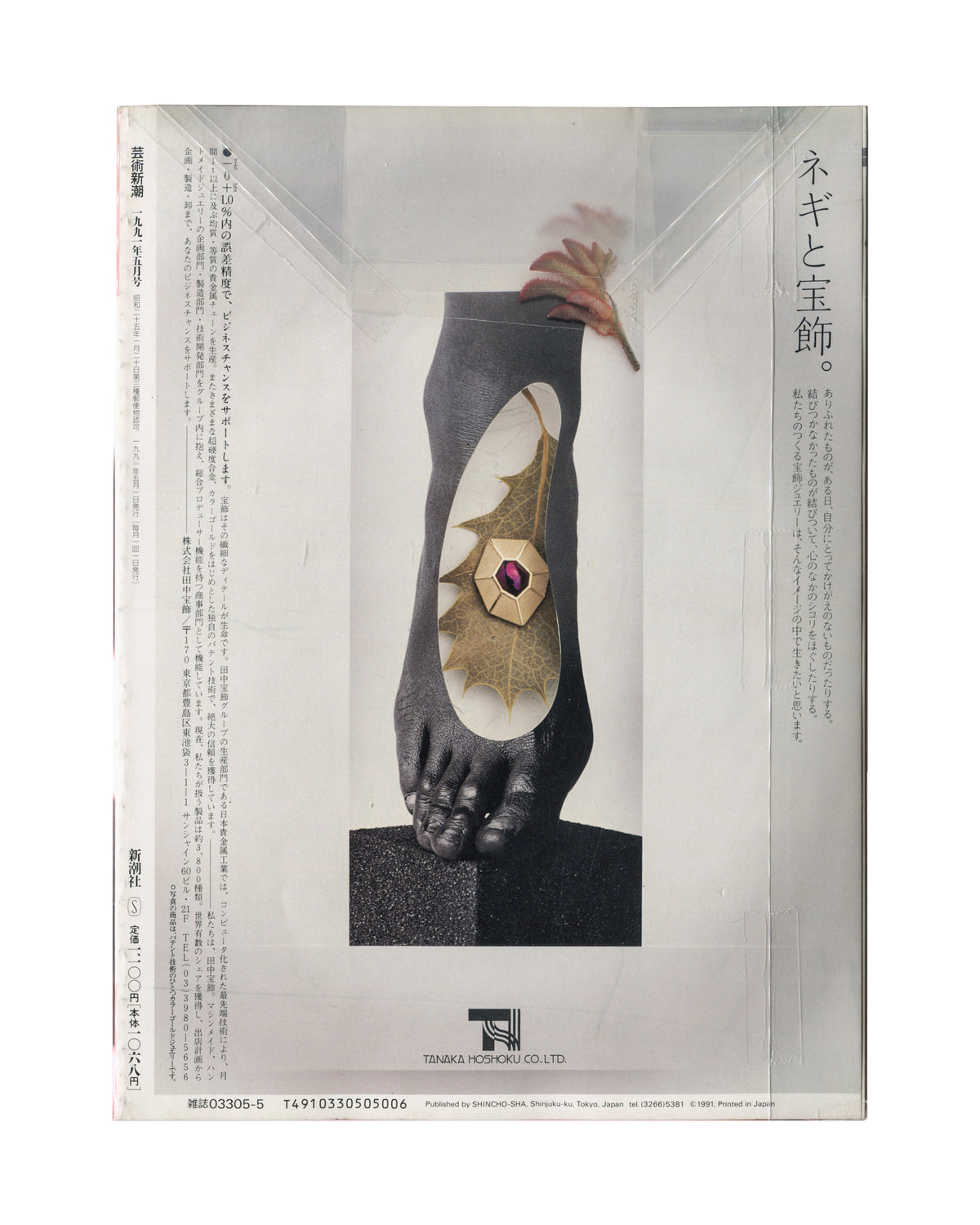
Condition: Good vintage condition. General rubbing, surface marks and light edge wear to covers, with handling consistent with age. Original price label and old clear tape present at upper-right front cover. Please refer to photographs.
Share