Collection: André Masson
André Masson (1896–1987, Balagny-sur-Thérain) was a French painter and draughtsman whose practice from the early 1920s onwards placed him at the centre of Surrealism and established automatic drawing as one of the movement’s defining techniques. Severely wounded in the First World War — an experience that left lasting psychological and physical effects — Masson developed a practice rooted in violence, eroticism, mythology and the unconscious.
His automatic drawings of 1924–25, produced by allowing the hand to move freely across the page without conscious direction, were among the earliest and most radical applications of automatism to visual art. His sand paintings of the same period, made by throwing glue and sand onto canvas and working into the resulting forms, extended this approach into three dimensions. Works such as Battle of Fishes (1926) and the Massacres series combined mythological violence with biomorphic abstraction in images of extraordinary intensity.
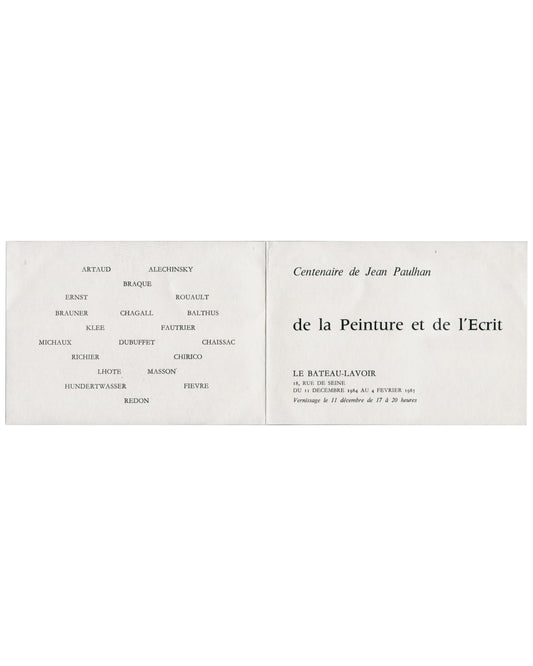
Masson’s friendship with Jean Paulhan — who championed his work through La Nouvelle Revue française — was among the most significant of his career. His inclusion in Centenaire de Jean Paulhan: De la peinture et de l’écrit (Le Bateau-Lavoir, Paris, 1984) reflects that longstanding connection. His work is held in major collections including the Centre Pompidou, Paris, and the Museum of Modern Art, New York.