Collection: Pierre Alechinsky
Pierre Alechinsky (born 1927, Brussels) is a Belgian painter and printmaker whose practice from the late 1940s onwards developed a gestural, calligraphic approach to painting rooted in automatic writing, Eastern calligraphy and the expressive traditions of CoBrA, the international avant-garde movement he joined in 1949.
A founding member of CoBrA alongside Karel Appel, Asger Jorn and Constant, Alechinsky contributed to the movement’s rejection of geometric abstraction in favour of spontaneous, figurative and mythological imagery drawn from folk art, children’s drawing and the unconscious. Following CoBrA’s dissolution in 1951, he settled in Paris, where he studied printmaking under Stanley William Hayter at Atelier 17 and developed a sustained engagement with etching, lithography and artists’ books.
A journey to Japan in 1955 deepened his interest in calligraphy and ink painting, leading to the film Calligraphie japonaise (1955) and a body of work in which the painted mark was treated as a form of writing and the written mark as a form of painting. His large-scale works of the 1960s and 1970s, often incorporating painted borders of smaller images surrounding a central composition, established him as one of the most distinctive voices in European post-war painting.
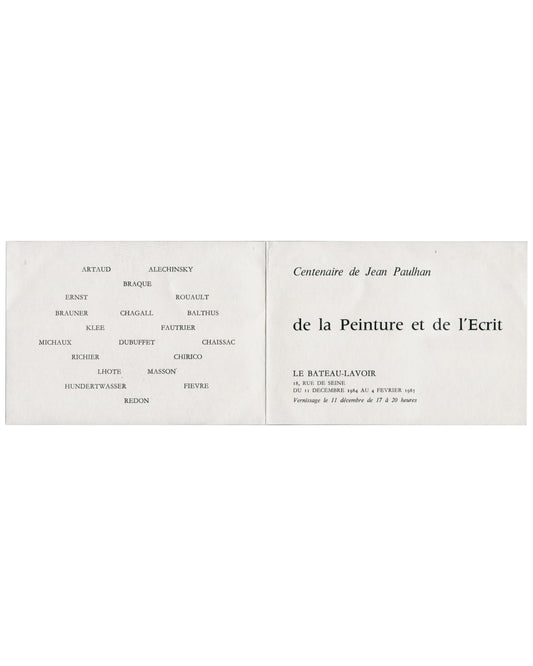
Alechinsky’s participation in Centenaire de Jean Paulhan: De la peinture et de l’écrit (Le Bateau-Lavoir, Paris, 1984) reflects his longstanding engagement with the relationship between painting and writing. His work is held in major collections internationally, including the Centre Pompidou, Paris, and the Museum of Modern Art, New York.