Collection: Jorge Camacho
Jorge Camacho (1934, Havana — 2011, Paris) was a Cuban-born painter who became one of the most distinctive figures within the international Surrealist movement. After studying law in Havana, he moved to Paris in 1959, where he met André Breton in 1961 and was formally welcomed into the Surrealist circle. His work was included in the last major Surrealist group exhibitions and continued to develop the movement’s preoccupations long after its dispersal.
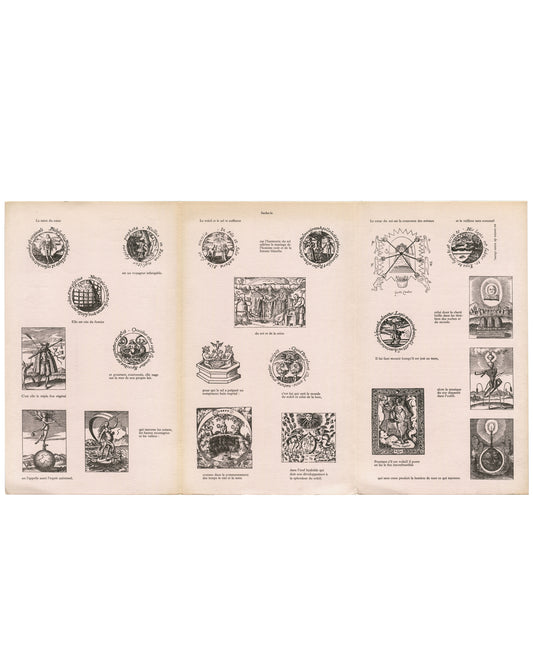
Camacho’s painting is dense, hermetic and technically exacting. His canvases accumulate layered forms — hybrid creatures, alchemical symbols, fragmented anatomies, ritual objects — rendered in fine, controlled brushwork against grounds of deep colour or near-darkness. From the late 1960s, alchemy became a sustained framework for his practice, pursued through close study of historical texts and through exchanges with writers and researchers including Bernard Roger. The exhibition publication Le Ton Haut (Galerie Mathias Fels, Paris, 1969) documents this period directly, combining Camacho’s emblems with Roger’s text and adapted historical engravings in the form of a small hermetic manual.
Camacho exhibited widely across Europe and the Americas, with major presentations at Galerie Mathias Fels in Paris, and his work entered significant public and private collections internationally. Publications produced in connection with his exhibitions — catalogues, folded announcements, illustrated checklists — are among the most visually concentrated documents of post-war Surrealism in France.