Collection: Henri Michaux
Henri Michaux (1899–1984, Namur, Belgium) was a Belgian-French poet, painter and draughtsman whose practice across six decades developed one of the most singular and unclassifiable bodies of work in twentieth-century art and literature. Resisting alignment with any movement, Michaux moved between poetry, travel writing, visual art and pharmacological experiment, treating each medium as a form of exploration and self-investigation.
His early poetry, including Ecuador (1929) and the Plume series, established a voice of radical interiority and dark humour. His visual practice, begun seriously in the 1930s, produced ink drawings, watercolours and gouaches in which marks, signs and invented scripts traced the movements of thought and sensation across the page. Works made under the influence of mescaline in the 1950s and 1960s — documented in Misérable miracle (1956) and subsequent publications — extended this investigation into altered states of perception, producing images of extraordinary density and agitation.
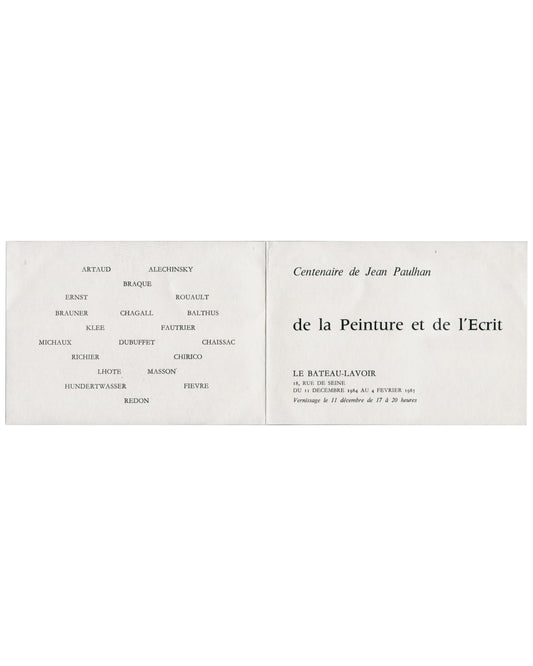
Michaux’s relationship with Jean Paulhan was longstanding and significant: Paulhan published his work through La Nouvelle Revue française and was among the earliest advocates of his visual practice. His inclusion in Centenaire de Jean Paulhan: De la peinture et de l’écrit (Le Bateau-Lavoir, Paris, 1984) reflects that connection and his position at the intersection of writing and visual art. His work is held in major collections including the Centre Pompidou, Paris, and the Museum of Modern Art, New York.