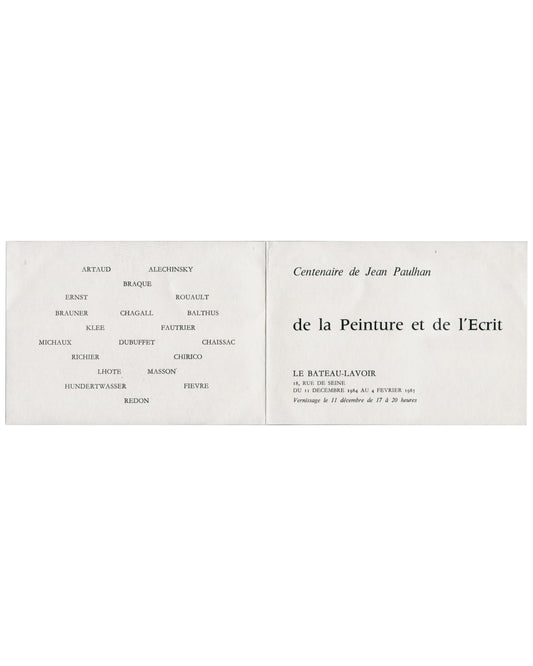
Collection: Odilon Redon
Odilon Redon (1840–1916, Bordeaux) was a French painter, draughtsman and printmaker whose practice across five decades produced one of the most singular and visionary bodies of work in nineteenth and early twentieth-century art. Working largely outside the dominant movements of his time — Impressionism, Naturalism, Symbolism — Redon developed an imagery of fantastical creatures, disembodied eyes, floating heads, botanical forms and mythological figures that drew on dreams, literature and the natural sciences in equal measure.
His early work in charcoal and lithography, produced between 1879 and 1900 and published in albums including À Edgar Poe (1882), Les Origines (1883) and La Tentation de Saint Antoine (1888–96), established him as the supreme practitioner of the fantastic in graphic art. The dense, velvety blacks of his noirs — achieved through a mastery of charcoal and lithographic crayon — gave his imagery an atmospheric intensity that no reproduction fully captures.
From around 1900, Redon turned increasingly to colour, producing pastel drawings and oil paintings of extraordinary luminosity — flower pieces, mythological subjects and decorative panels — that brought his work to wider public attention. His friendship with Symbolist writers including Stéphane Mallarmé and Joris-Karl Huysmans, and his influence on the Nabis and later on Surrealism, confirmed his position as a pivotal figure between nineteenth-century Symbolism and the twentieth-century avant-garde. His work is held in major collections internationally, including the Musée d’Orsay, Paris, and the Museum of Modern Art, New York.