Collection: Jean Dubuffet
Jean Dubuffet (1901–1985, Le Havre) was a French painter, sculptor and theorist whose practice from the early 1940s onwards mounted one of the most sustained and provocative challenges to the values of Western high culture in twentieth-century art. Rejecting academic training and the refinements of the European tradition, Dubuffet developed a deliberately crude, anti-aesthetic approach to painting that drew on graffiti, children’s drawing, the art of the mentally ill and the visual residue of everyday urban life.
His concept of Art Brut — raw art made outside the conventions of professional artistic practice — led him to assemble an extensive collection of works by self-taught, marginalised and institutionalised artists, now housed as the Collection de l’Art Brut in Lausanne. His own paintings of the late 1940s and 1950s, including the Corps de dames series and the Texturologies, used thick impasto, sand, tar and other materials to produce surfaces of aggressive materiality that deliberately violated the conventions of beauty and finish.
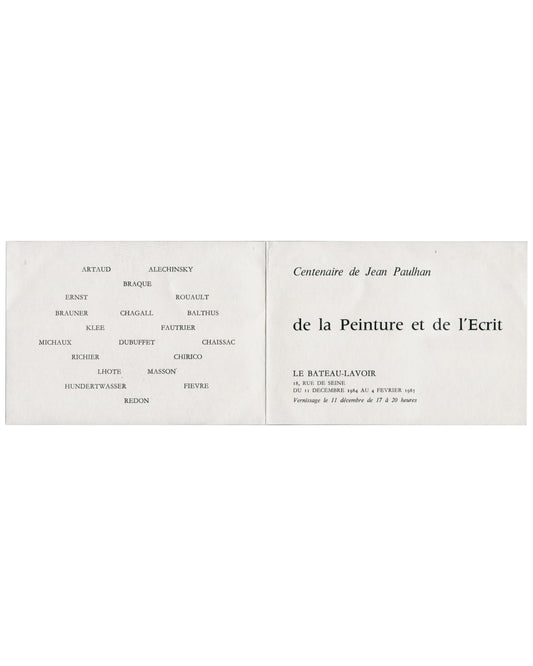
His later Hourloupe cycle (1962–74), developed from doodles made during telephone conversations, produced an interlocking system of red, white and blue cell-like forms that he extended across paintings, sculptures, architectural environments and theatrical productions. Dubuffet’s friendship with Jean Paulhan — who was among the earliest supporters of his work — made his inclusion in Centenaire de Jean Paulhan: De la peinture et de l’écrit (Le Bateau-Lavoir, Paris, 1984) particularly fitting. His work is held in major collections internationally, including the Centre Pompidou, Paris, and the Museum of Modern Art, New York.