Collection: Giorgio de Chirico
Giorgio de Chirico (1888–1978, Volos, Greece) was an Italian painter whose work from 1909 to 1919 produced the foundational imagery of metaphysical painting and established a visual language of dreamlike urban spaces, classical statuary, long shadows and enigmatic juxtapositions that would profoundly influence Surrealism and the broader course of twentieth-century art.
His Pittura Metafisica works — including the Piazze d’Italia series, the Muse Inquietanti and paintings of mannequins, towers and arcaded squares bathed in raking afternoon light — created an atmosphere of melancholy, displacement and hidden meaning that Andre Breton and the Surrealists recognised as anticipating their own concerns. Works such as The Song of Love (1914) and The Uncertainty of the Poet (1913) remain among the most reproduced images in modern art.
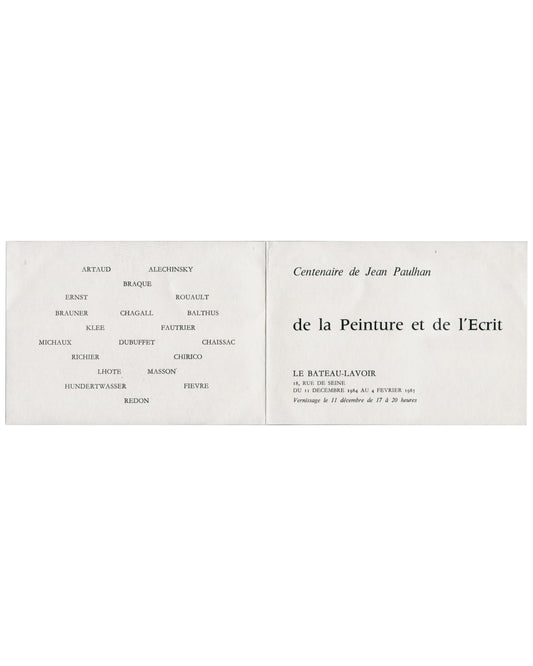
De Chirico’s later repudiation of his early work — his return to academic painting, his production of replicas and his public disputes with the Surrealists — made him a controversial figure, but also one whose relationship to his own image world raised fundamental questions about authenticity, repetition and artistic identity. His inclusion in Centenaire de Jean Paulhan: De la peinture et de l’écrit (Le Bateau-Lavoir, Paris, 1984) reflects his enduring presence in the French cultural imagination. His work is held in major collections internationally, including the Museum of Modern Art, New York, and the Museo Nacional Thyssen-Bornemisza, Madrid.