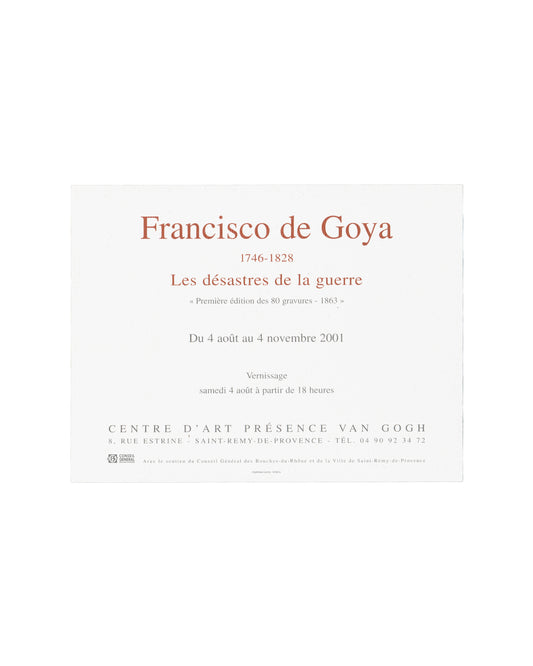
Collection: Francisco de Goya
Francisco de Goya (1746, Fuendetodos — 1828, Bordeaux) was a Spanish painter and printmaker whose work spans the late eighteenth and early nineteenth centuries and whose graphic series remain among the most powerful documents of war, violence and social critique in the history of Western art. Court painter to the Spanish Crown from 1786, Goya worked simultaneously within and against the conventions of his time, producing official portraits and religious commissions alongside privately made works of extraordinary darkness and formal invention.
His three major print series — Los Caprichos (1799), The Disasters of War (c. 1810–20) and The Disparates (c. 1815–23) — were made in etching and aquatint and circulated in limited or posthumous editions. The Disasters of War, begun in response to the French occupation of Spain and the Peninsular War, records atrocity, famine and the collapse of civil order across eighty plates. Goya did not publish the series during his lifetime; it was finally issued by the Real Academia de Bellas Artes de San Fernando in Madrid in 1863, thirty-five years after his death.
Goya’s late work, including the Black Paintings made directly onto the walls of his house outside Madrid between 1819 and 1823, anticipates the concerns of Expressionism, Surrealism and twentieth-century figurative painting. His influence on subsequent art history is without parallel among artists of his period. Exhibition invitations and printed matter produced in connection with his work document the continued international circulation of his graphic series across institutions and centuries.