Arts Council of Great Britain
PAUL DE MONCHAUX, FENELLA CRICHTON AND KATE BLACKER, The Sculpture Show, Hayward Gallery / Serpentine Gallery, 1983
PAUL DE MONCHAUX, FENELLA CRICHTON AND KATE BLACKER, The Sculpture Show, Hayward Gallery / Serpentine Gallery, 1983
Couldn't load pickup availability
Published by Arts Council of Great Britain / Hayward Gallery / Serpentine Gallery, London, 1983. Selected by Paul de Monchaux, Fenella Crichton and Kate Blacker. 19.5 × 24.3 cm, 148 pages. ISBN 0-7287-0370-X.
The title promises a number. The exhibition immediately disputes it. The cover calls it Fifty Sculptors; the catalogue itself documents 48; a companion brochure counts 52; the Serpentine's own later reconstruction puts actual participation at 53, uncertain in part because a few names — Richard Long, Andy Frost, John Cobb — worked across more than one site and get counted more than once. Nobody organising the largest living-sculpture exhibition Britain had yet held could agree on how many sculptors were in it.
That instability runs all the way down to where the work physically sat. At the Serpentine, Bill Culbert's Small Glass, Pouring Light shared the gallery with Richard Deacon's Two can play and Laura Ford's Sea Slugs; outside in Kensington Gardens, David Nash's Sod Swap, William Tucker's Victory and Kevin Atherton's Three Bronze Deckchairs took the show onto public grass and pavement. The Hayward held the densest concentration — Kapoor, Gormley, Cragg, Woodrow, Wentworth, Willats, Wilding, Boyd Webb, Julian Opie, Edward Allington, Jean-Luc Vilmouth, Shirazeh Houshiary, Yoko Terauchi — none of them yet carrying the institutional weight their names would later accumulate. And down at the South Bank, Ian Hamilton Finlay, David Mach and Rachel Fenner closed out a checklist that by the time it reached its final entry, Sarah Bradpiece's Wash Station, had numbered 102 individual works across four locations that had nothing obviously in common except the word “sculpture.”
De Monchaux, Crichton and Blacker weren't building a survey. They opened submissions to around 400 artists and filled nearly half the show from that pool, then let the selection argue with itself: Richard Long, already internationally established through walking and Land Art, sitting in the same building as artists just starting out. Kapoor's pages here show pigment on the floor — small, material, nothing like the monumental polished forms that would later define him publicly. Gormley shows Natural Selection and Three Places, eight years before the Turner Prize he hadn't won yet even existed to win. Deacon, Cragg, Long, Kapoor and Gormley would take four of the first six Turner Prizes, 1987 through 1994 — but on these pages none of that has happened.
The catalogue's own structure refuses to settle either. Essays from Bryan Robertson, Nicholas Wadley, Stuart Morgan, Deanna Petherbridge and Nena Dimitrijević run alongside artist questionnaires, biographies, and photographs of work that in several cases no longer physically exists. And bound into the book is Audio Arts’ Objects & Spaces — a transparent 7-inch flexi-disc, not documentation of a sculpture but presented as one. William Furlong and Michael Archer’s Audio Arts had spent a decade recording artists talking about their own work; here, inserted into the pages of an Arts Council catalogue, sound itself gets counted among the fifty.
The separate folded List of Works completes the set: a navigational document, not a reflective one, numbering those 102 works in the order a 1983 visitor would have physically encountered them, opening with Kate Blacker’s own Monument in Progress and closing, four sites and 102 entries later, with a mixed-media washstand nine metres tall. Once the show closed, the sheet had no further use. That’s exactly why a surviving example, still with the catalogue it was issued alongside, now matters.
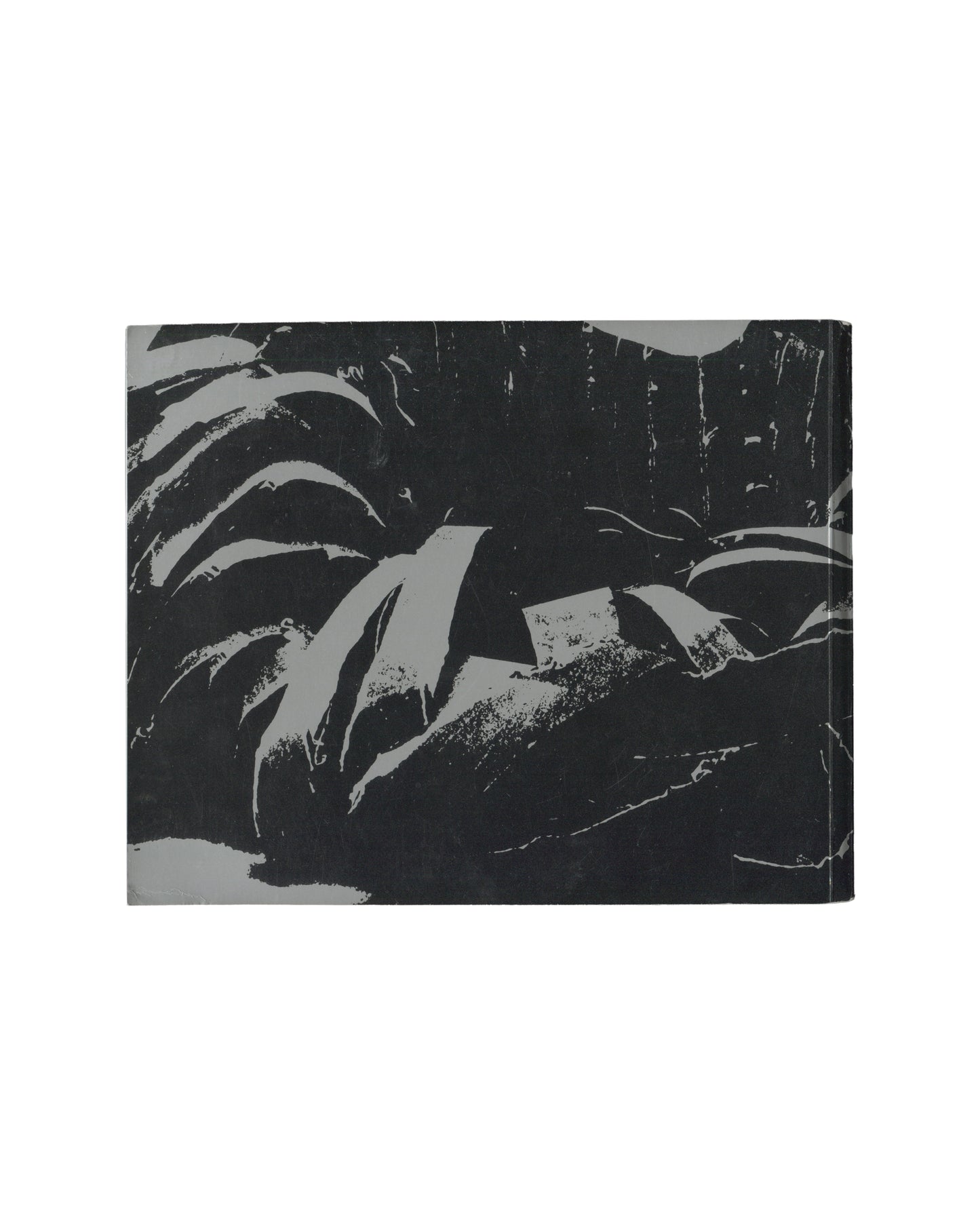
Condition: Original illustrated wrappers, good to very good for age — surface rubbing, scratches and edge wear consistent with genuine handling; interior spreads clean with light toning. Complete with the original transparent Audio Arts Objects & Spaces flexi-disc and the separate folded List of Works.
Fifty was never the real number. The exhibition still hasn’t decided what it was — and this copy still has every part of it that could have gone missing.
Share