Walther König
STEPHEN PRINA, The Second Sentence of Everything I Read Is You, Staatliche Kunsthalle Baden-Baden, 2008
STEPHEN PRINA, The Second Sentence of Everything I Read Is You, Staatliche Kunsthalle Baden-Baden, 2008
Couldn't load pickup availability
Published by Walther König, Köln, 2008/2009. Texts by Astrid Wege, Bennett Simpson and Karola Grässlin. 21.5 × 27 cm, 176 pages. Published for Staatliche Kunsthalle Baden-Baden and Centro Andaluz de Arte Contemporáneo, Sevilla.
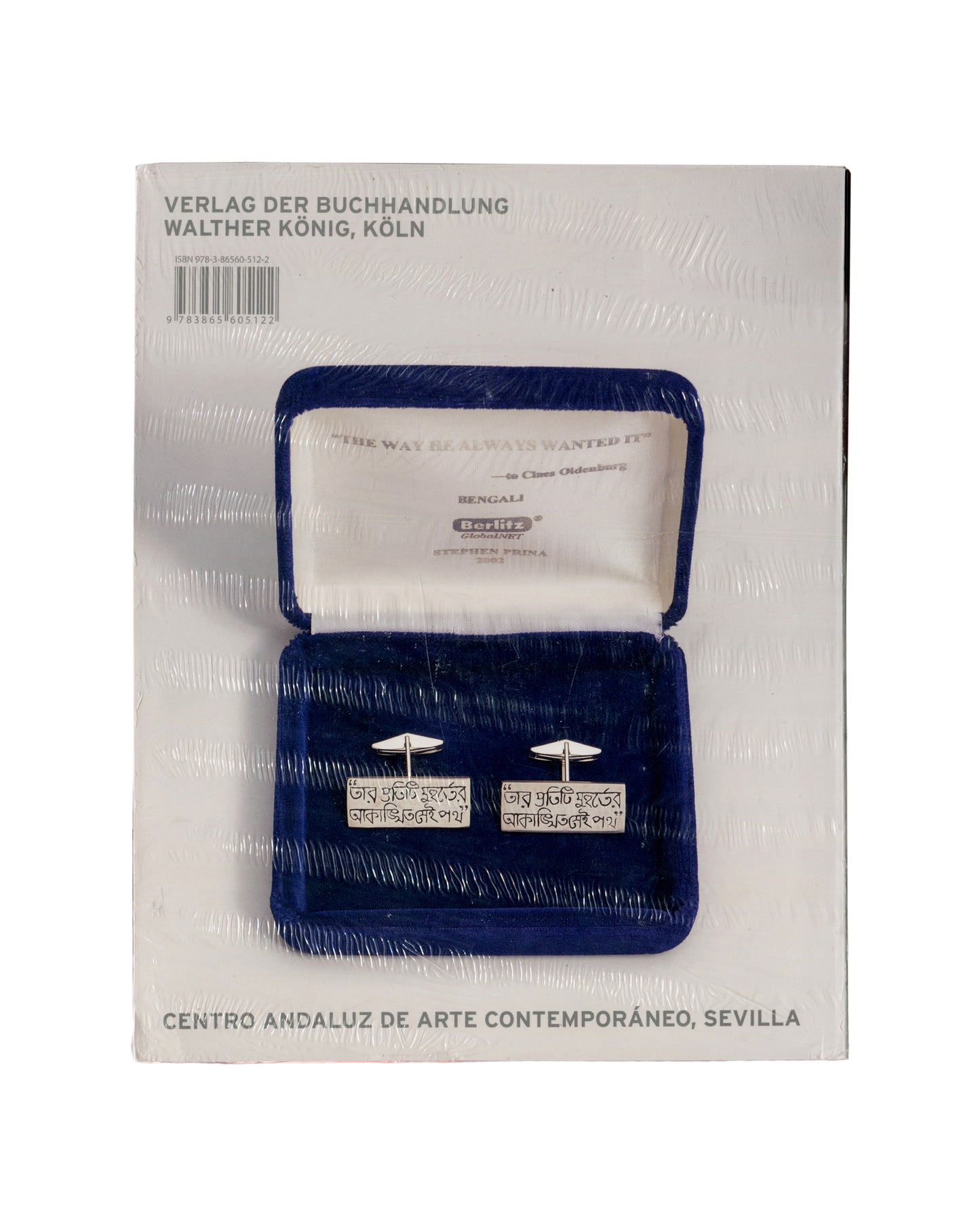
Condition: Still factory shrink-wrapped, unopened. A later Momox resale barcode is affixed to the rear panel, retained as found.
Two jewellery boxes are dedicated to Claes Oldenburg, although neither contains an Oldenburg. The cufflinks inside — Prina's 2002 work Haberdashery — carry two phrases translated through Berlitz GlobalNET: "THE WAY HE ALWAYS WANTED IT" in Bengali and "U.S. OUT OF THE MIDDLE EAST" in Nepali. The first phrase already had a history. In 1979 it titled an unrealised re-spatialisation of Schoenberg's Sechs kleine Klavierstücke for 1,081 loudspeakers; in 2002 it became a pair of cufflinks; in 2008, a 35mm film shot inside Bruce Goff's Ford House; by 2013, a flute sextet, performed again at MoMA in 2025. The phrase keeps moving. Only its support changes.
That movement between existing things — artworks, books, architecture, music, language, memories and other artists — is central to Prina's practice, and this substantial catalogue surveys work produced from 1979 to 2008.
Even its title is borrowed from an exchange. Writer Lynne Tillman told Prina that the first sentence of a text needed to seize its reader; Prina turned the thought into The Second Sentence of Everything I Read Is You, the recurring title for a series of installations. In Mourning Sex (2005–07), a song composed and performed by Prina uses quotations from and about Felix Gonzalez-Torres, drawn largely from a book edited by Julie Ault. The work travels in crates that become benches when exhibited; the crates and carpet retain the stains and scuffs accumulated through storage, shipping and repeated installation. Circulation is allowed to remain visible.
A different kind of displacement produced As He Remembered It. Walking along La Brea Avenue with Christopher Williams in the 1980s, Prina encountered a bright-pink built-in desk designed by R. M. Schindler, removed from its architectural setting and displayed as an autonomous object. Prina later described it as appearing like an "amputated limb." The memory eventually generated an installation of twenty-eight reconstructed elements of Schindler furniture, themselves removed once again from the buildings that had given them meaning.
Then there is Wade Guyton. Beginning with their 2010 exhibition at Friedrich Petzel, Prina applied PUSH COMES TO LOVE — the contents of an enamel spray can — directly onto Guyton's Epson-printed linen paintings. Prina's intervention itself reaches backwards to Lawrence Weiner, turning a conceptual proposition into another action, on another support, by another artist. Guyton and Prina continued producing these works together over subsequent years.
And behind all of this sits Exquisite Corpse: The Complete Paintings of Manet, begun on 1 January 1988: Prina's ongoing undertaking to work through all 556 paintings by Édouard Manet listed in an outdated catalogue raisonné, retaining dimensions, titles and catalogue information while removing the original pictorial image. Art history arrives not as something to illustrate, but as an existing information system available to be used again.
Mike Kelley belongs to the story differently: as friend, peer and collaborator from Prina's CalArts world. Kelley, choreographer Anita Pace and Prina created Beat of the Traps in 1992, combining dance, percussion, rock mythology and contemporary pop music. Dormant for more than three decades, it was reconstructed at MoMA in 2025 and is scheduled to return at MOCA Los Angeles in September 2026.
What ties Oldenburg, Schoenberg, Ault, Gonzalez-Torres, Williams, Schindler, Weiner, Guyton, Manet and Kelley together here is not influence in the conventional sense. Prina repeatedly begins with something that already has an author, a history and a location, then moves it.
This copy belongs to TNR's Shrinkwrapped collection: books that never entered circulation at all. Every other surviving copy of this catalogue was, at some point, opened — read, shelved, reshelved, marked up, resold. This one wasn't. It sat still in Baden-Baden's plastic while its own subject matter kept moving without it: the phrase kept touring, the cufflinks kept meaning something new, Manet's 556 paintings kept getting remade one at a time. A Prina object that refused to circulate is, in its own way, the most Prina object there is.
Museum catalogue → commercial distribution → second-hand marketplace → another context.
The object stays put. Its meaning doesn't.
Share