Taxes included.
Tate Gallery, London, 27 September 1994–8 January 1995. 21 × 29.5 cm. 6 pp. Folded exhibition handout, offset-printed in black and white throughout. Text by Sean Rainbird, Curator, Modern Collection. Designed and published by Tate Gallery Publications, London. Condition: very good. Light handling, minor creasing and edge wear consistent with an original gallery-distributed handout; small signs of age and circulation visible throughout.
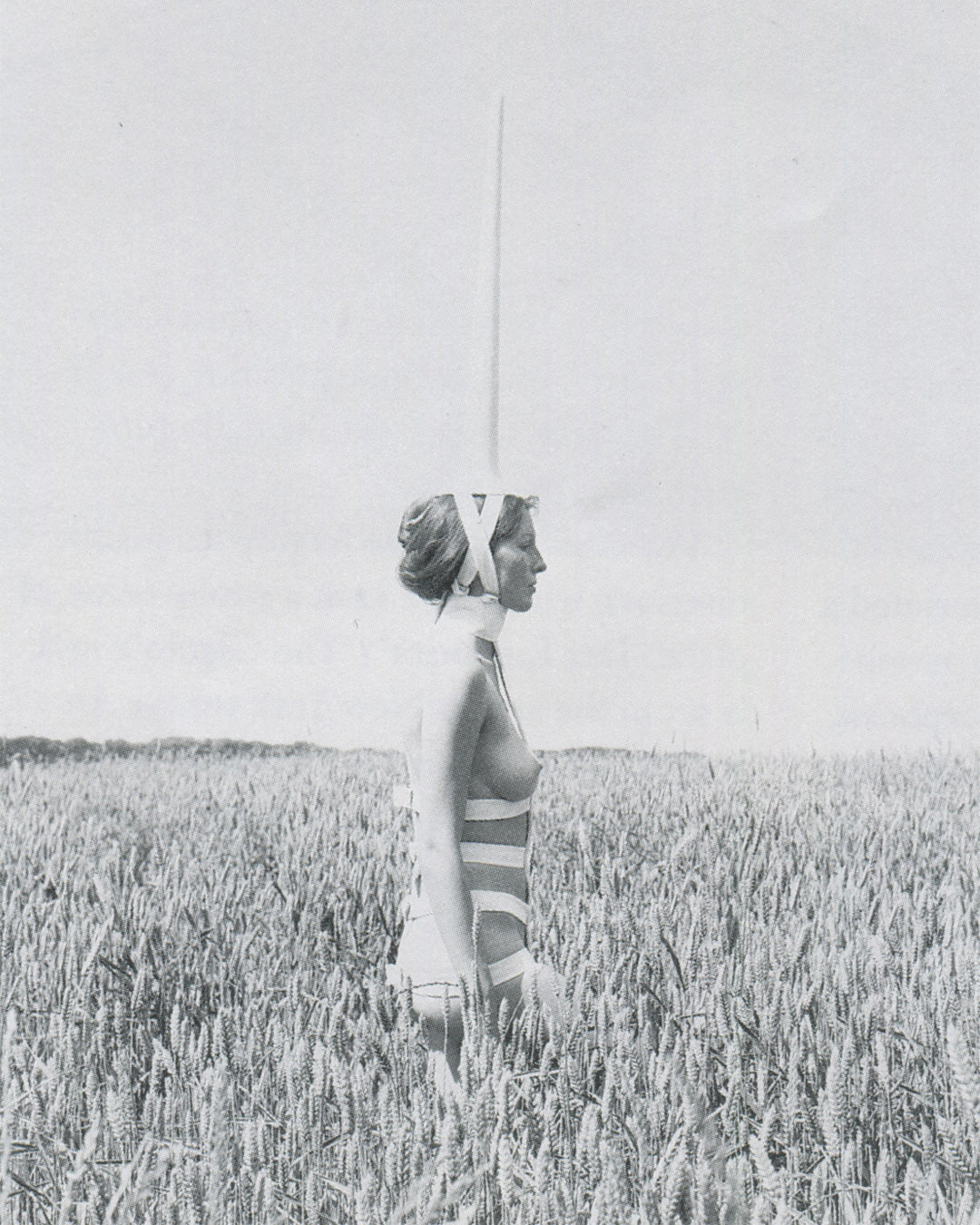
In 1993, the Guggenheim Museum gave Rebecca Horn a solo retrospective — the first time in the institution's history it had given one to a woman. That show didn't stay in New York. It travelled: to the Stedelijk Van Abbemuseum in Eindhoven, to the Nationalgalerie in Berlin, to the Kunsthalle in Vienna, and finally to London, where it landed simultaneously at two institutions — Tate Gallery and the Serpentine — each running its own dates, each presenting its own selection from the same touring body of work. This six-page handout is Tate's contribution to that moment: the folded paper object a visitor picked up on the way into the galleries, not the retrospective catalogue that survives it.
Its checklist compresses twenty-five years into four columns, in date order, beginning with Arm Extensions (1968) and ending with three works made that same year — Earthbound (London), Inferno, London, The Trial (all 1994). In between: the early prosthetic body extensions, the mirror rooms, the mercury and feathers and psychologically unstable machines that made Horn's reputation. The object's own text, written by Tate's Sean Rainbird, is precise about one work in particular — Ballet of the Woodpeckers (1986): visitors' footfalls would set mercury trembling in floor-mounted funnels, vibrations that recalled the patients present when the piece was first installed in the foyer of a theatre inside a Viennese psychiatric institution. Hammers peck against mirrors in an uneven rhythm, pausing and then striking without warning, likened by Horn herself to birds flying at their own reflection, nearly destroying themselves before they see what they're approaching.
The cover image is Concert for Anarchy (1990) — a grand piano suspended upside down from the ceiling, its keyboard cover snapping open at intervals to eject the keys outward before slowly drawing them back in, wires audibly straining on the return. It is as good a single image as exists for what Horn's machines do throughout this checklist: ordinary objects — a piano, a mirror, a pair of shoes, a hammer — pushed until they behave like something with a nervous system rather than a mechanism.
A catalogue is built to last; a handout is built to be used up. This one was designed to be carried through rooms that have since been dismantled, describing works that were, by definition, temporary installations — mercury poured out, pianos lowered back down, mirrors packed away. The exhibition disappeared. The object that oriented a visitor inside it did not. What's left is a modest, precisely dated, exactly placed six-page survival from the exact months Horn's international reputation was being consolidated across five cities — evidence of an exhibition rather than a record produced after the fact to commemorate one.
This object is discussed in RE:Circulation No. 007 — How Things Enter History.