Rafael Melendez
Rafael Melendez — Born to Die
Rafael Melendez — Born to Die
Couldn't load pickup availability
Unique artist’s book / assemblage publication
2016
Approx. 32 + 32 pages (64 pages total)
Digitally manipulated screenshots and found images with text interventions
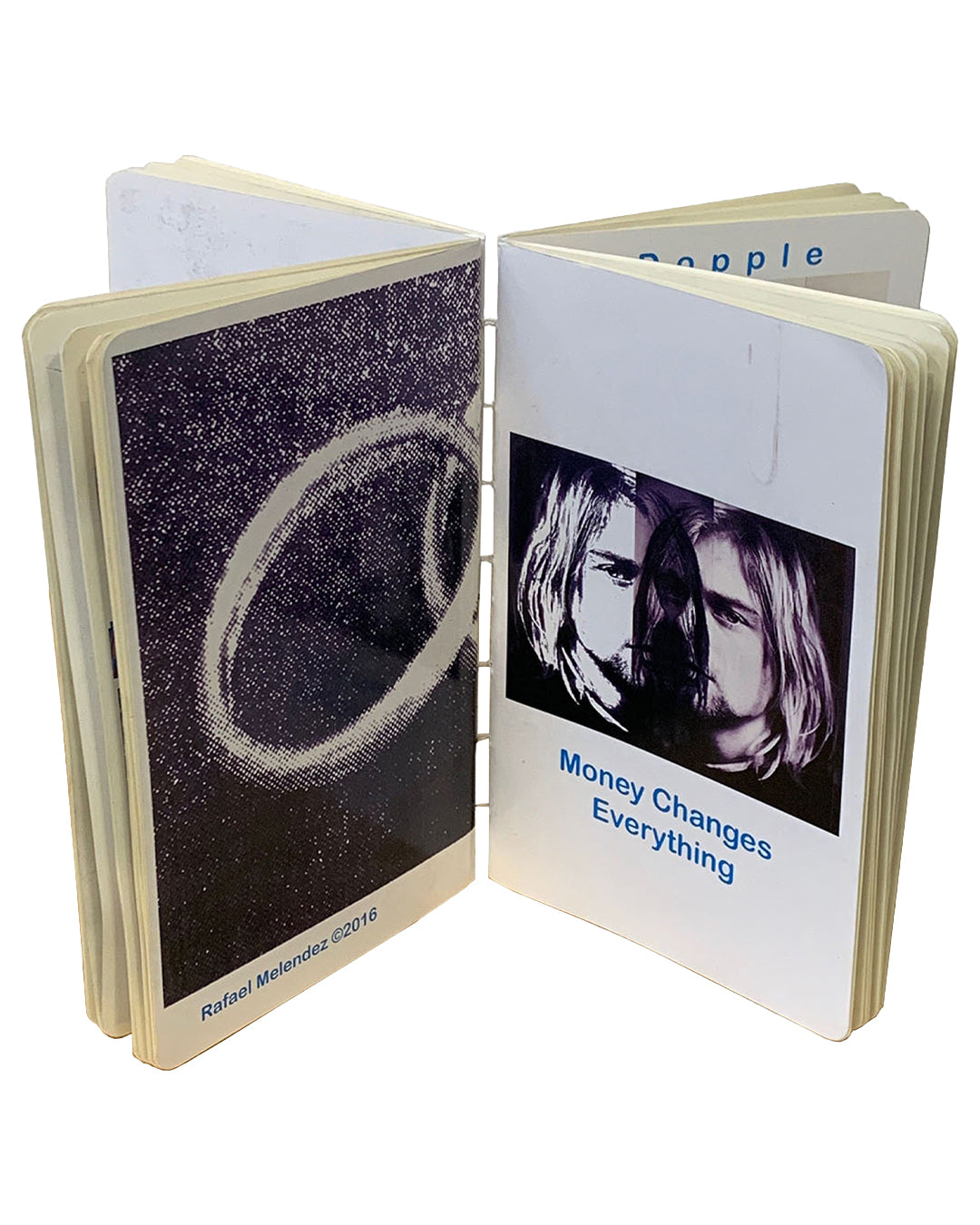
Hand-assembled and bound from two separate books joined at the spine
One-of-one
Condition: unique handmade object with minor handling marks and material irregularities intrinsic to production.
Born to Die began through the collection of screenshots, saved images, and text fragments gathered and reorganized through a stream-of-consciousness process. Images were resized, cropped, duplicated, and altered through simple consumer software applications, allowing the work to remain close to the logic of accumulation rather than formal composition.
The publication takes Marina Abramović and Ulay’s performances Relation in Time (1977) and Rest Energy (1980), together with Louise Bourgeois’s Janus (1968), as underlying structural references rather than subjects for illustration. The paired body, the doubled body, tension, attachment, mirroring, dependence, and psychic division move through the publication in fragmented form.
Physically, the work consists of two separate 32-page books later joined into a single object through a dos-à-dos (back-to-back) binding structure, assembled with a deliberately loose spine connection. Traditionally the format allows two books to occupy one body while retaining separate orientations; here the logic is disrupted. The work behaves less as a conventional artist’s book than as a conjoined structure — two image sequences temporarily sharing a support while remaining partially independent.
The title Born to Die introduces another circular structure: beginning and ending collapsed into a single phrase. Images circulate through the book in a similar way, appearing as residues rather than stable illustrations. Figures split, repeat, and return. Authorship itself moves between source material, appropriation, editing, and assembly.
Unique work. Original period item.
Share