Actes Sud
LOUISE BOURGEOIS: THE BLIND LEADING THE BLIND, Mâkhi Xenakis, Actes Sud / Galerie Lelong, 2008
LOUISE BOURGEOIS: THE BLIND LEADING THE BLIND, Mâkhi Xenakis, Actes Sud / Galerie Lelong, 2008
Couldn't load pickup availability
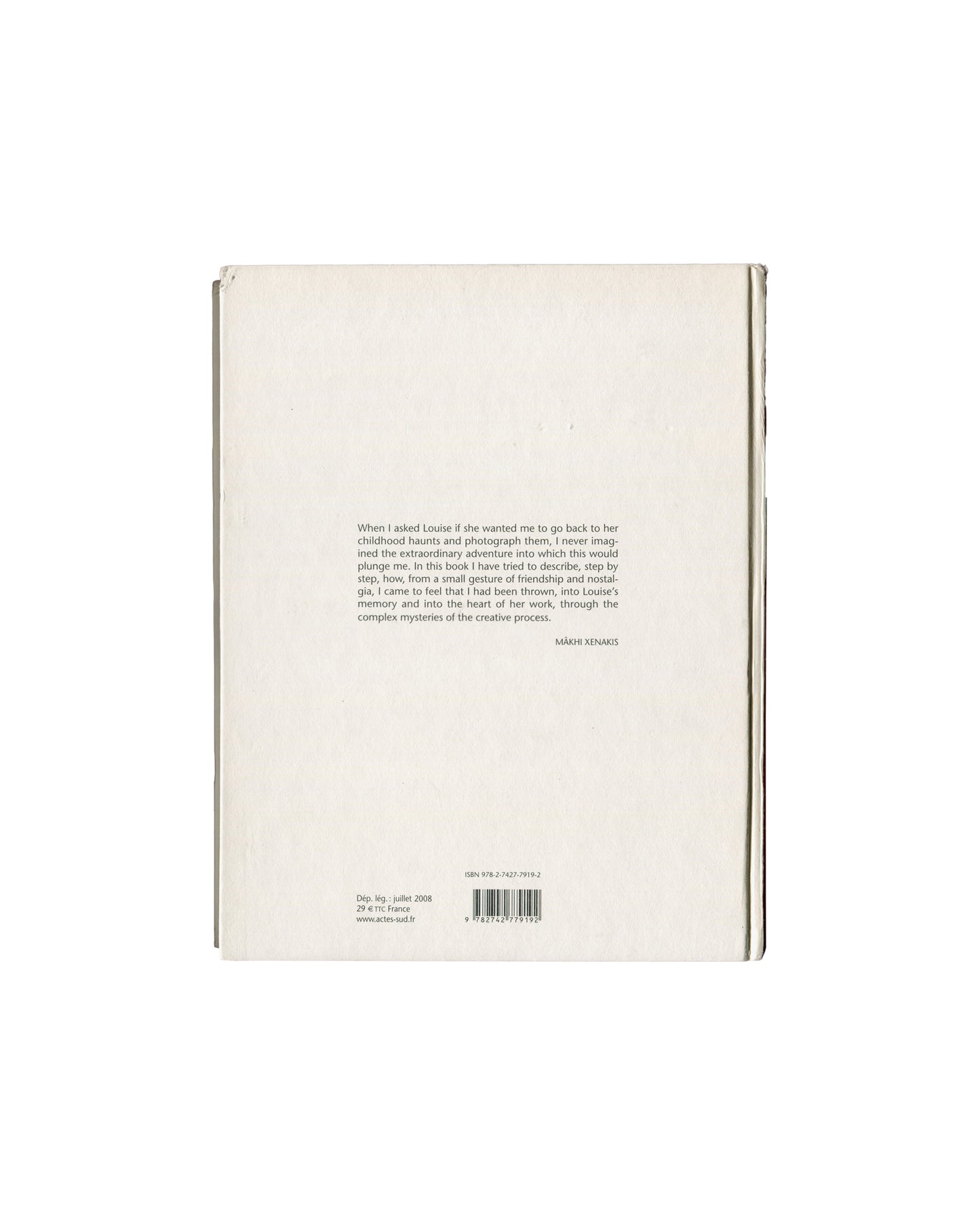
Hardcover, 22 × 28.5 cm, 112 pp. Actes Sud / Galerie Lelong, 2008. English text, translated from the French by Madeleine Vedel and Ruth Marshall. ISBN 978-2-7427-7919-2. English-language edition of the project first published in French in 1998 as Louise Bourgeois: L'aveugle guidant l'aveugle. Now out of print.
In 1987, Mâkhi Xenakis — an artist trained in architecture under Paul Virilio — arrived in New York on a Villa Médicis grant to paint. Within the year she had destroyed her own canvases. She spent months copying Velázquez and Rembrandt at the Met as a kind of therapy and studying archaic Greek sculpture, before touring SoHo galleries almost as an afterthought. She came across Louise Bourgeois's work without knowing anything about the artist and assumed, from the work alone, that Bourgeois was her own age. She found her number, wrote, received no reply, then called. Bourgeois questioned her coolly before asking what she could do for her. Xenakis answered: “Save my life.”
That is not a detached biographer's premise. It is one artist in crisis approaching another. What followed was a long friendship and, eventually, this book.
At Bourgeois's request, Xenakis went back through the physical remains of Bourgeois's childhood: schools, archives and family locations Bourgeois herself had not revisited in decades. She became, in effect, a proxy researcher into someone else's memory — gathering photographs, school registration records, correspondence notebooks and Bourgeois's own recollections while Bourgeois remained in New York, directing the search from a distance.
The book does not organise this material into the conventional sequence of biography followed by artwork. Documents and finished works are placed directly beside one another and the reader is left to notice what happens between them.
One spread does this with total clarity. A page from Bourgeois's geometry notebook, dated 1926 — postulates, diagrams, a schoolgirl's careful hand — sits opposite pages from The Puritan, her 1990 text-and-engraving work. Nothing tells you how to read the pairing. The notebook simply sits there, sixty-four years older than the work beside it, and the adjacency begins to suggest a mind already concerned with systems, relationships and structures that hold.
Another spread does something similar with the body. A photograph of Bourgeois as a girl of about eleven, wearing a white dress at the Hôtel des Anges in Le Cannet, faces Bourgeois decades later wearing the costume from her 1978 performance A Banquet/A Fashion Show of Body Parts — a garment constructed from bread rolls. Child and artist, dress and body, memory and object occupy facing pages without any claim that one explains the other.
The book lets you see the recurrence. It does not tell you what it proves.
That restraint is the real proposition here. The archive is not supplemental material illustrating the art. Once placed beside the work, it becomes part of how the work is read. A childhood notebook becomes evidence. A family photograph becomes part of an artist's vocabulary. An archive becomes a route through the work. Biography becomes material.
Condition: Good. Illustrated boards show edge rubbing, corner wear and handling, particularly at the spine ends and outer corners. Internally clean; pages remain bright and well preserved. The visible wear records the subsequent handling of a book concerned throughout with the recovery and reassembly of traces.
Share