Museum Fodor / Stedelijk Museum
KUNST UIT NIEUW GUINEA — Museum Fodor / Stedelijk Museum, Amsterdam, 1963
KUNST UIT NIEUW GUINEA — Museum Fodor / Stedelijk Museum, Amsterdam, 1963
Couldn't load pickup availability
Museum Fodor / Stedelijk Museum, Amsterdam, 1963. Exhibition catalogue. Designed by Gerda C. van der Laan. Softcover, stapled wrappers, 24 pp., 19 × 26 cm. Black-and-white photographic plates. Catalogus no. 337.
Published for the exhibition Kunst uit Nieuw Guinea, Museum Fodor, Amsterdam, 22 May – 30 June 1963. Works from the private collection of Peter Kohler, Ascona, including objects from the Sepik, Yuat, Keram, and Korewori River regions, the Chambri Lakes area, and Manam Island.
A compact exhibition document built from image, region, collection, and sequence. The cover places a single carved figure against a largely empty field, title set in ochre lowercase. Inside, the catalogue proceeds through isolated reproductions: masks, sculptural figures, textile fragments, ritual forms, carved objects held against blank paper.
The design is restrained and sharply staged. A brown vertical band runs through the interior spreads, functioning almost as a filing edge or display strip. Objects are numbered rather than explained at length. A private ethnographic collection becomes a municipal exhibition record: photographed, ordered, and circulated through the Stedelijk/Museum Fodor apparatus.
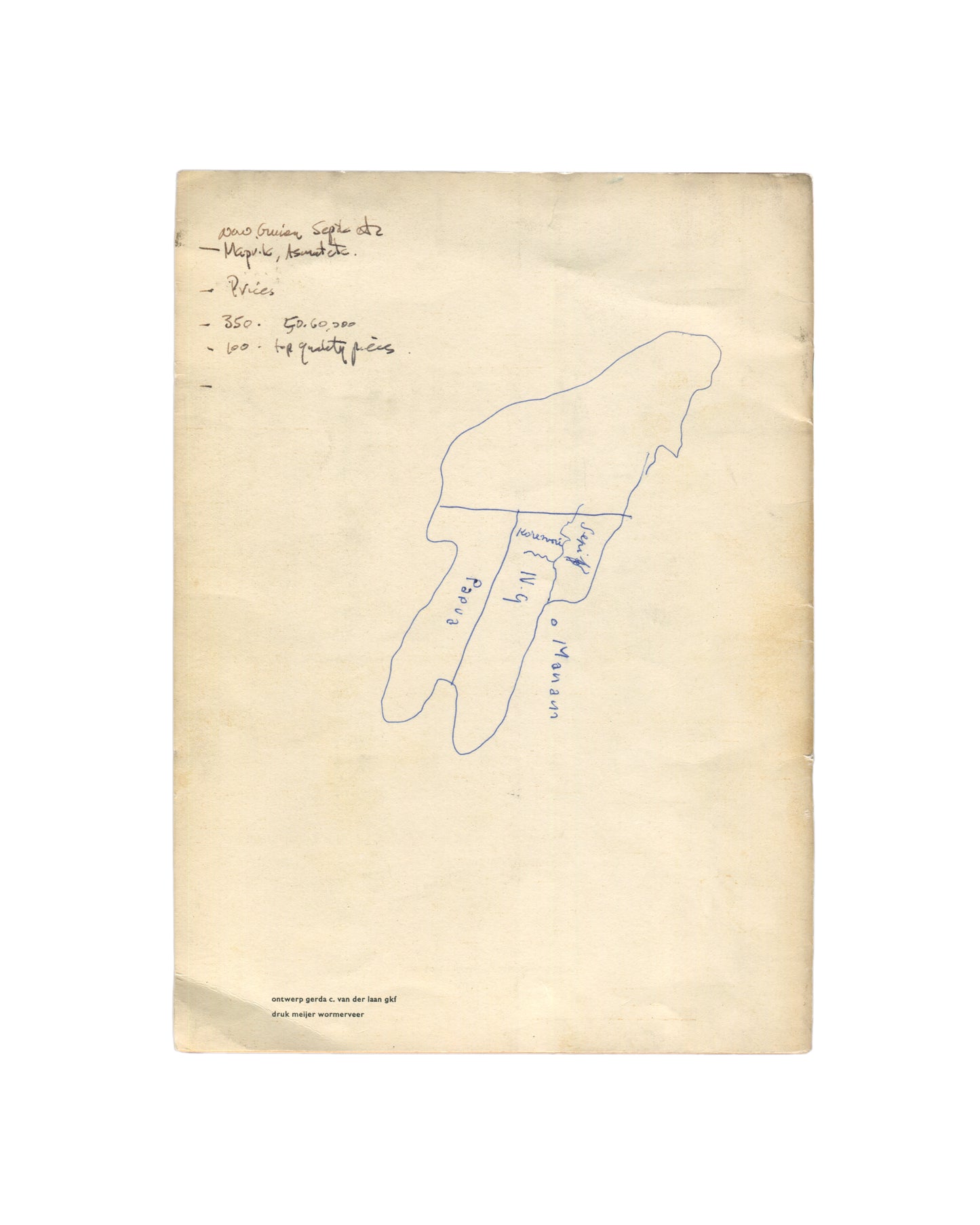
The back cover carries later handwritten notes and a sketched map-like form in blue ink — marking the object’s secondary life after the exhibition. These additions do not interrupt the catalogue so much as extend its condition: New Guinea becomes image, route, note, price, and retained paper.
Condition: Good. General toning, handling marks, soft creases, edge wear to wrappers. Handwritten annotations and blue-ink drawing to rear cover. Stapled binding intact. Original period item.
Share