Vintage Books
JOHN WATERS — Crackpot: The Obsessions of John Waters, Vintage Books, 1987
JOHN WATERS — Crackpot: The Obsessions of John Waters, Vintage Books, 1987
Couldn't load pickup availability
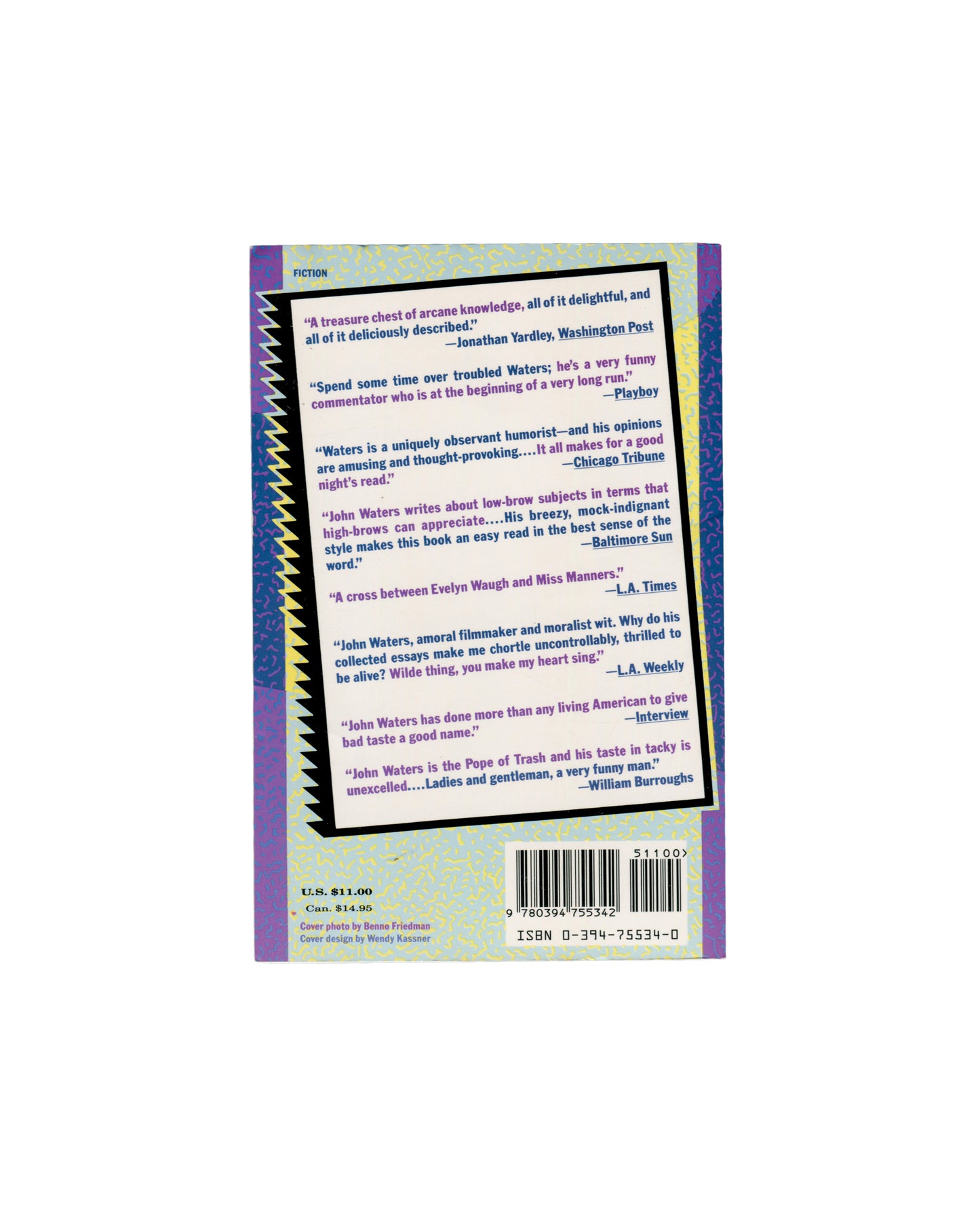
John Waters, Crackpot: The Obsessions of John Waters. Vintage Books, New York, 1987. Softcover; 144 pages, 20.32 × 13.2 cm; colour illustrated wrappers; English. Cover photograph by Benno Friedman; design by Wendy Kassner. ISBN 0-394-75534-0.
A mass-market paperback that can be read as a small manifesto for cultural refuse. Crackpot collects Waters’ writing on the people, places and forms of popular culture normally positioned outside respectable criticism: tabloids, exploitation cinema, celebrity, bad taste, Baltimore, Hollywood and the assorted obsessions from which he built his larger cultural position.
Waters’ commitment to trash is more than an affection for vulgarity. It is a reversal of value. What culture dismisses as embarrassing, disposable, excessive or beneath serious attention becomes precisely where he chooses to look.
Seen within a longer postwar lineage, Crackpot occupies an interesting position. Wolf Vostell worked with the damaged surfaces and debris of mass communication, while Boris Lurie and NO!art rejected the expectation that difficult, vulgar or contaminated material should be cleaned up through good taste. Waters transfers that proposition into popular culture itself. His trash is often cultural rather than physical: failed celebrity, supermarket tabloids, exploitation movies, suburban perversity and everything respectable culture has already decided not to take seriously. He does not rescue this material by making it tasteful. He changes the hierarchy by taking it seriously in the first place.
Decades later, Dan Colen’s Trash works return the proposition to material form, bringing discarded street matter and other abject materials directly into contemporary painting. Across this loose lineage, the terms shift but the underlying reversal remains: Vostell disrupts the debris of mass culture; Lurie refuses to clean it up; Waters turns what culture considers trash into a cultural position of its own; Colen puts trash back into the artwork as material.
Crackpot sits particularly well within that trajectory because the book itself participates in the argument. It does not arrive as a theoretical reader or precious artist publication, but as a cheap, brightly packaged, widely circulated paperback — the kind of commercial cultural object Waters continually defended. The form and the position coincide: a book about what culture dismisses, circulated through one of its most ordinary and disposable forms. The book does not document trash culture from the outside. It belongs to it.
Condition: Very good. Light rubbing and handling wear to wrappers, with minor edge and corner wear consistent with age.
Securely packed; tracked UK and international shipping available.
Share