Kiepenheuer & Witsch
JENNY HOLZER — Kunst Heute Nr. 9, Kiepenheuer & Witsch, Cologne, 1993
JENNY HOLZER — Kunst Heute Nr. 9, Kiepenheuer & Witsch, Cologne, 1993
Couldn't load pickup availability
Kiepenheuer & Witsch, Cologne, 1993. First edition. Jenny Holzer im Gespräch mit Noemi Smolik, edited by Wilfried Dickhoff. Softcover, 96 pages, 16 × 23 cm. Black-and-white illustrations throughout. German language. ISBN 3-462-02297-0.
Published in 1993 as the ninth volume of Kunst Heute: Gespräche mit zeitgenössischen Künstlern, this book records an extended conversation between Jenny Holzer and critic Noemi Smolik, edited by Wilfried Dickhoff. The date is the thing. Holzer had begun with the anonymous street posters of Truisms in 1977–79, moved language onto electronic signs and billboards through the 1980s, filled the Guggenheim with LEDs in 1989, and in 1990 became the first woman to represent the United States at the Venice Biennale with a solo presentation, winning the Golden Lion. By 1992–93 the work was turning toward increasingly explicit accounts of war, violence and the body: War followed the Gulf conflict, while Lustmord began in 1993 in response to sexual violence during the war in Bosnia.
Kunst Heute Nr. 9 sits directly inside that transition. The images make the genealogy visible: one spread returns to Holzer’s public billboards — “It is man’s fate to outsmart himself” occupying an ordinary urban streetscape; another reproduces Lady Pink wearing a 1983 T-shirt carrying the Truisms line “ABUSE OF POWER COMES AS NO SURPRISE.” Street, body, clothing, billboard, electronic sign: language repeatedly leaves the page and finds another support.
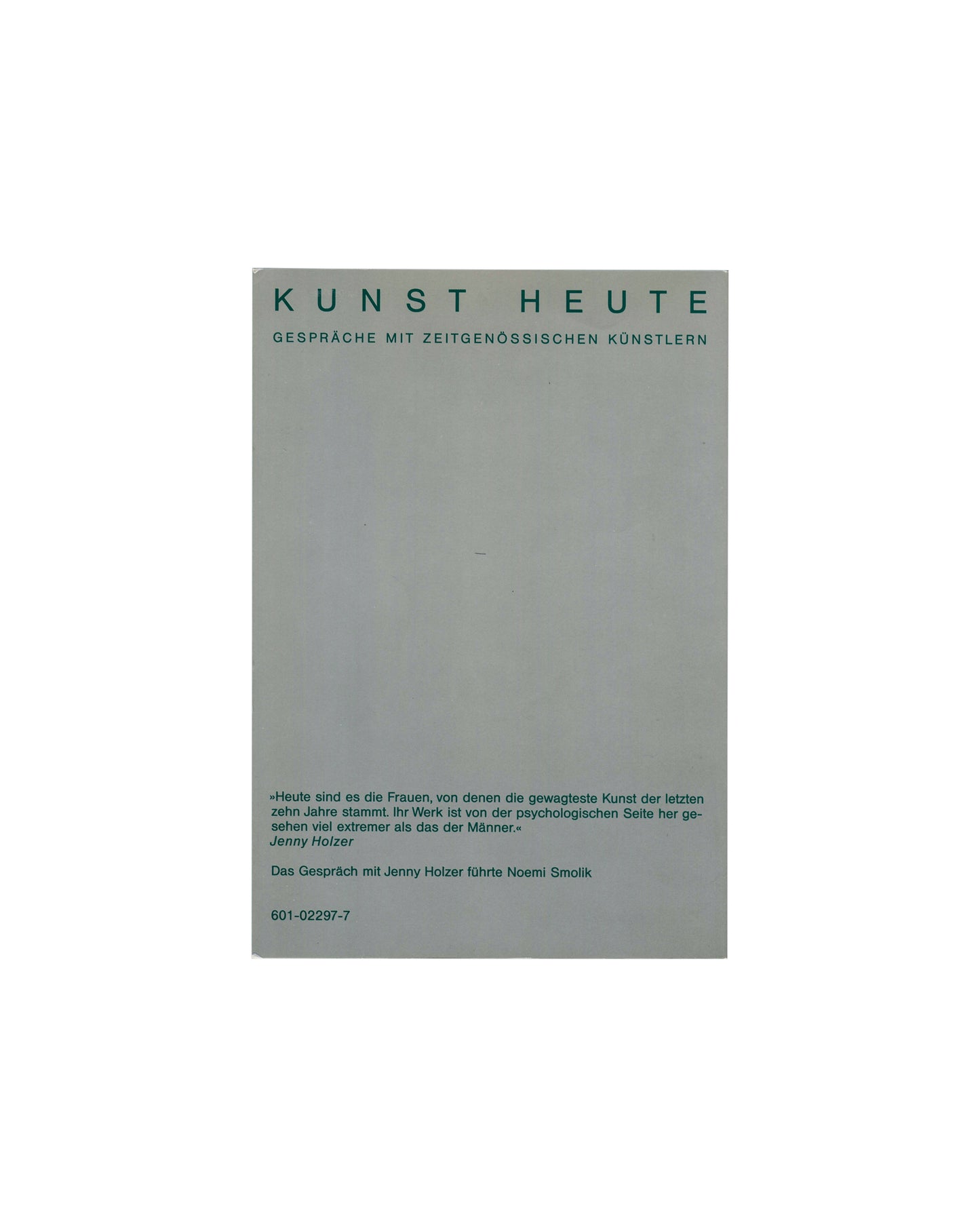
On the rear cover Holzer makes the politics unusually explicit, arguing that the most daring art of the previous decade had come from women, whose work she considered psychologically more extreme than men’s. Smolik would return to Holzer only three years later as editor of Jenny Holzer: Writing / Schriften, making this smaller 1993 interview an earlier point in an important critical relationship.
The words begin on paper. The work begins when they leave it.
Condition: very good. Light handling and minor edge wear consistent with age.
Share