Galleria Schwarz
FRANCIS PICABIA, Mécanique / Dada 5, Galleria Schwarz, Milan, 1964
FRANCIS PICABIA, Mécanique / Dada 5, Galleria Schwarz, Milan, 1964
Couldn't load pickup availability
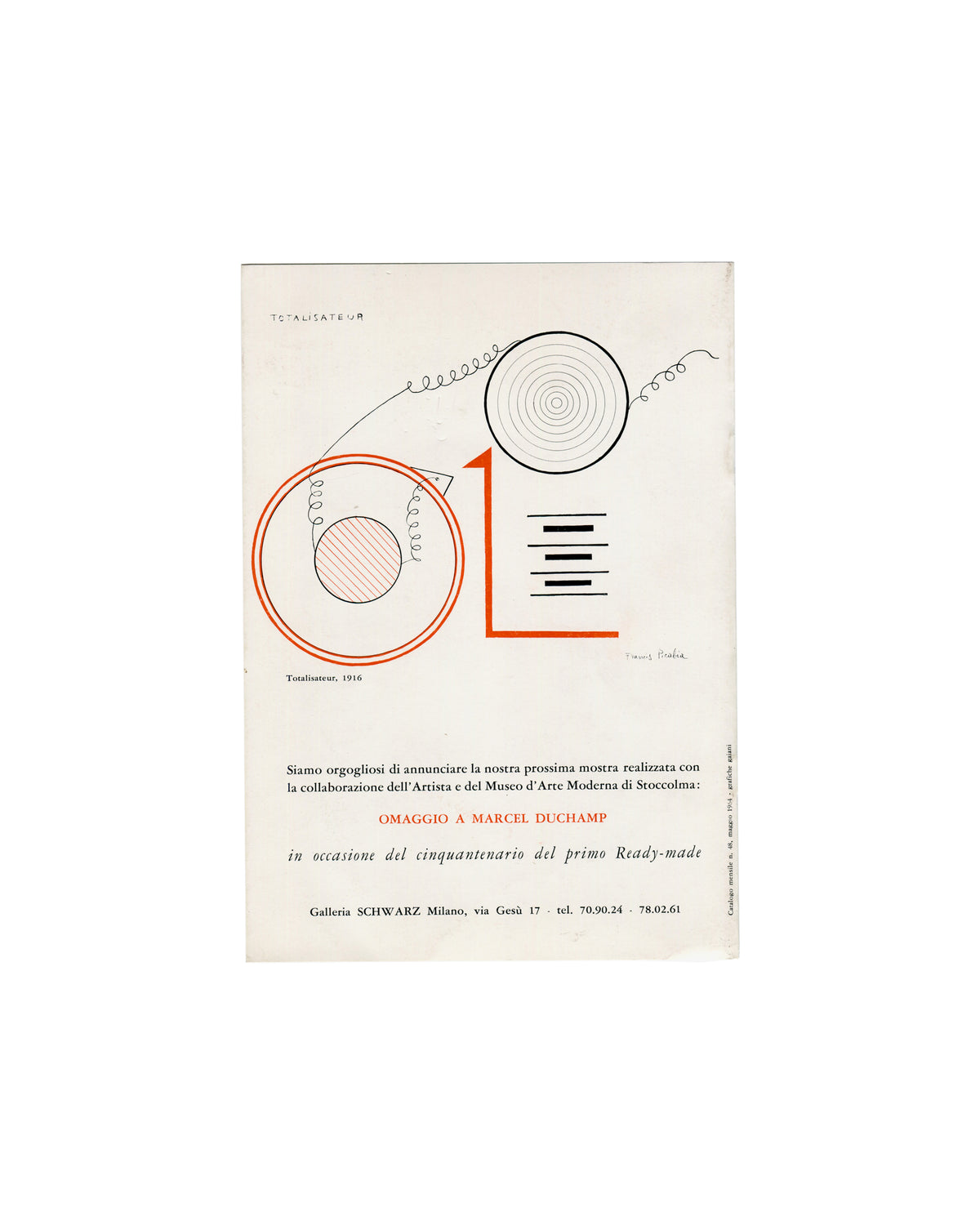
Catalogo mensile, no. 48. Exhibition: 5 May–1 June 1964. 16.5 × 23.5 cm. 14 pp. Staple-bound exhibition catalogue in illustrated wrappers. Offset-printed, black-and-white with spot-colour reproductions. Text in Italian, French and English. Introductory essay by Marcel Duchamp; separate biographical chronology (gallery-compiled); reproductions of Picabia's mechanomorphic works including Totalisateur, Danseuse Jasmine, Machine tournez vite, Volucelle and Les Centimètres. Condition: very good. Light age-toning and handling to wrappers, minor rubbing, faint soiling, slight corner and edge wear consistent with a sixty-year-old exhibition catalogue. Interior pages clean and bright; binding sound.
By 1964 Francis Picabia had been dead for eleven years. Nothing in this catalogue happens in his world — it happens in the world being built around it, almost entirely by one man. Arturo Schwarz, an Egyptian-born dealer, poet and Duchamp scholar, had converted his Milan publishing house into a gallery on Via Gesù in 1961, and had spent the following years turning that address into one of Europe's central relay points for Dada — exhibiting it, publishing it, and, in 1964 specifically, remaking it. That same year, working under Duchamp's direct supervision, Schwarz produced numbered editions of eight replicas each of fourteen of Duchamp's readymades — objects that had mostly been lost, discarded, or never built to last. Only seven of the fourteen originals still existed by the 1960s. The replicas are now the form in which most museums hold the work at all.
That project sits directly behind this pamphlet, not beside it. The catalogue documents Picabia's mechanomorphic period — roughly 1915 to 1921, when Picabia, working in close proximity to Duchamp in wartime New York, began routing bodies, sex and social relation through gears, diagrams and pseudo-engineering. Machine tournez vite, reproduced here in blue, black and gold, reduces a man and a woman to two numbered, interlocking gears — mechanism standing in for intimacy, precisely because intimacy is what mechanism refuses to explain. The work dates to 1916–18; Picabia's mechanical drawings had begun appearing the year before, developed alongside Duchamp and Man Ray in the circle later credited with originating New York Dada.
Duchamp's own contribution is the catalogue's second axis. Writing about a former collaborator eleven years dead, he doesn't smooth Picabia's fifty-year swerve between Impressionism, near-abstraction, Dada mechanics, academic watercolours and late transparencies into a coherent style. He argues the opposite: that the refusal to settle is the coherence. Picabia's career looks kaleidoscopic because Picabia would not submit to a formula — not academic convention, and not, pointedly, whatever formula the avant-garde itself might have offered him instead. Coming from Duchamp, who spent his own career refusing to repeat himself in almost the identical way, this reads less as art criticism than as one survivor identifying his own logic in somebody else's life.
The rear wrapper announces Schwarz's next show — Omaggio a Marcel Duchamp, organised with the artist and with Stockholm's Moderna Museet, marking fifty years since the first readymade. The gallery's own arithmetic points to the 1914 Bottle Rack as that anniversary's reference point — a period claim worth holding as the gallery's framing rather than restating as settled art history. What matters more is the timing: this announcement runs concurrently with the same year Schwarz was physically fabricating the objects that would make Duchamp's own readymades legible to a museum-going public for the first time in decades.
So the catalogue does two things at once, and neither is incidental. Inside, Duchamp fixes Picabia's historical position — an old friend, writing the case for coherence-through-inconsistency, at exactly the moment that argument had a receptive audience again. Outside, the same gallery, the same year, the same dealer, is already announcing the next artist's canonisation. One exhibition catalogue is quietly handing off to the next: mechanomorphic drawing becomes readymade sculpture, a wartime avant-garde becomes a postwar gallery programme, and a fourteen-page pamphlet becomes a small, legible piece of the machinery by which Dada re-entered art history as scholarship, replica and market. The object stayed modest. What surrounds it did not.
This object is discussed in RE:Circulation No. 007 — How Things Enter History.
Share