Tate Publishing
ANDREW WILSON, ED. — Conceptual Art in Britain 1964–1979, Tate Publishing, 2016
ANDREW WILSON, ED. — Conceptual Art in Britain 1964–1979, Tate Publishing, 2016
Couldn't load pickup availability
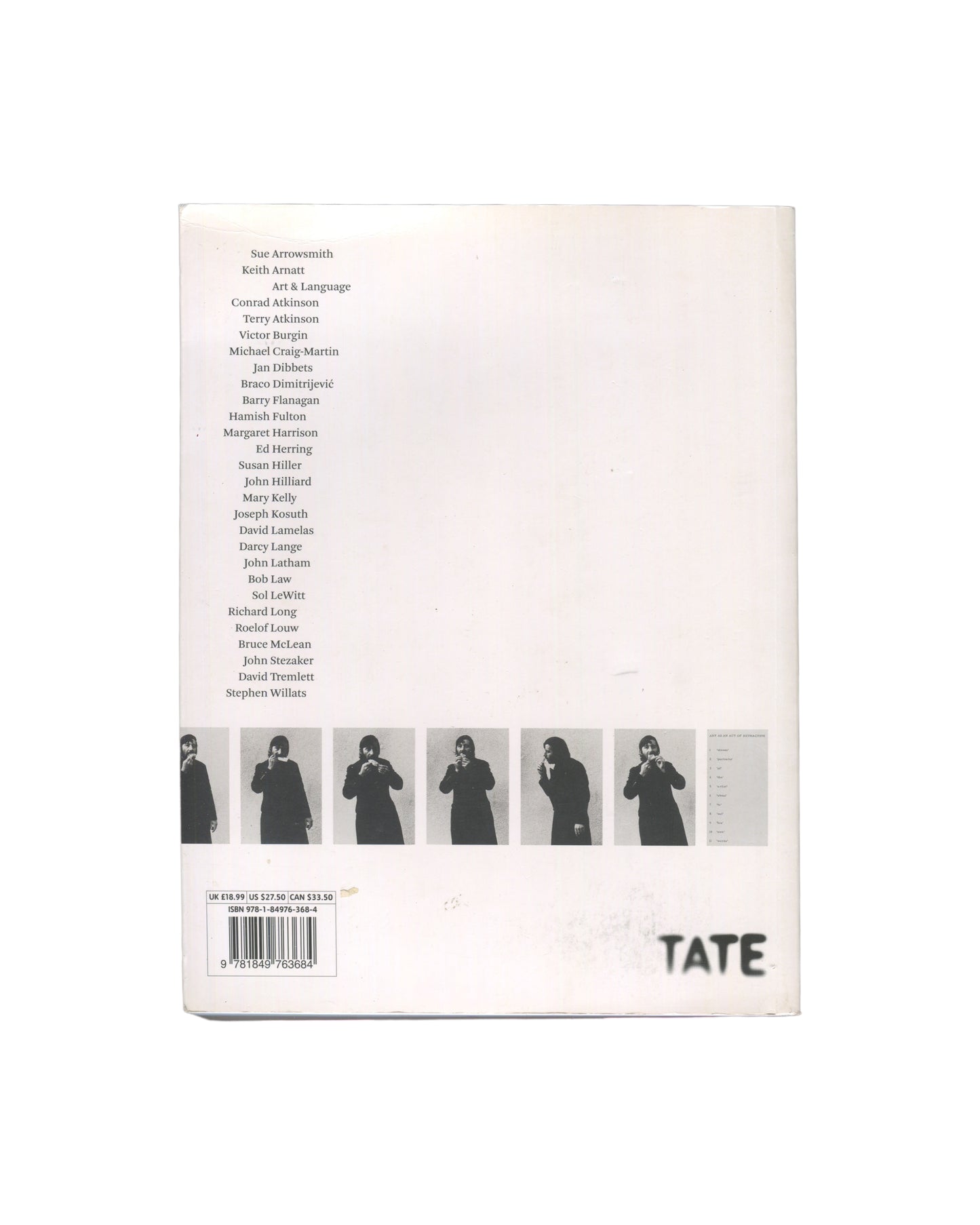
Andrew Wilson, ed., Conceptual Art in Britain 1964–1979. Tate Publishing, London, 2016. Softcover; 160 pages, 19 × 25 cm; illustrated throughout in colour and black-and-white. Published to accompany the exhibition at Tate Britain, London.
An exhibition catalogue that deserves to be considered as more than an exhibition catalogue.
Published for Tate Britain’s 2016 survey, Conceptual Art in Britain 1964–1979 reconstructs a period in which the definition of an artwork was being systematically dismantled. Sculpture became action; language became material; an instruction could replace an object; photography could function as evidence; and books, postcards, filing systems and documents could carry a work beyond the exhibition itself.
The book brings together an unusually concentrated group of artists who established and complicated that territory: Sue Arrowsmith, Keith Arnatt, Art & Language, Conrad Atkinson, Terry Atkinson, Victor Burgin, Michael Craig-Martin, Jan Dibbets, Braco Dimitrijević, Barry Flanagan, Hamish Fulton, Margaret Harrison, Ed Herring, Susan Hiller, John Hilliard, Mary Kelly, Joseph Kosuth, David Lamelas, Darcy Lange, John Latham, Bob Law, Sol LeWitt, Richard Long, Roelof Louw, Bruce McLean, John Stezaker, David Tremlett and Stephen Willats.
Read together, the list describes less a movement with a common appearance than a network of different answers to the same problem: if the artwork no longer has to look like an artwork, where does the work reside?
Bruce McLean turns the sculptural plinth into something to climb across, occupy and misuse in Pose Work for Plinths. David Lamelas reduces an event to the simple action of pouring milk into a glass. Bob Law proposes a drawing potentially extending to one million marks. Ed Herring places hundreds of postcards inside a filing cabinet. John Latham collapses book, ingestion, residue, archive and object into the same work. Elsewhere, photography, walking, language, advertising, administration, ownership, instruction and social systems become equally legitimate artistic material.
That makes the catalogue itself particularly interesting. Much of conceptual art was produced and circulated through precisely the formats traditionally considered secondary to art: photographs, typed instructions, publications, diagrams, postcards, photocopies and documentary records. This book therefore documents conceptual art using many of the same systems through which conceptual art originally existed. The document describes the work, but the history it describes had already made the document part of the work.
There is a second reversal. Practices that questioned permanence, authorship and the conventional art object eventually return through the museum: selected, photographed, captioned, sequenced, historicised and bound into 160 pages. What had been dispersed becomes a canon. What had been temporary becomes an archive. What questioned the art object becomes an object again.
Its relative ordinariness is part of its appeal. This remains an accessible Tate catalogue rather than a heavily fetishised piece of first-generation conceptual ephemera, yet contained within it is an unusually dense map of the conditions from which much contemporary practice still operates: instruction, appropriation, documentation, participation, distribution, language, administration, the body and the unstable boundary between artwork and information.
A history of dematerialisation, returned to circulation as a book.
Condition: Good to very good. Light rubbing, handling and edge wear to wrappers, with minor marks consistent with use. Interior clean from inspection.
Securely packed; tracked UK and international shipping available.
Share