Whitney Museum of American Art
ABJECT ART: Repulsion and Desire in American Art, Whitney Museum of American Art, New York, 1993
ABJECT ART: Repulsion and Desire in American Art, Whitney Museum of American Art, New York, 1993
Couldn't load pickup availability
Published by the Whitney Museum of American Art alongside Abject Art: Repulsion and Desire in American Art, 23 June–29 August 1993, this modest paperback belongs to one of the defining collisions between contemporary art, queer and feminist politics, the AIDS era and the American culture wars. ISP Papers No. 3.
Organised through the Whitney Independent Study Program by Craig Houser, Leslie C. Jones and Simon Taylor, the exhibition took Julia Kristeva’s theory of the abject — the bodily matter, identities and experiences a social order attempts to expel in order to define itself — and applied it to American art. The curators were not identifying a neat historical movement. They were constructing a new reading of the Whitney’s own collection.
Duchamp, Pollock, Oldenburg, Warhol, Louise Bourgeois and Yayoi Kusama could suddenly be read alongside Robert Gober, Mike Kelley, Kiki Smith, Cindy Sherman, Andres Serrano, David Wojnarowicz and others through dirt, bodily fluids, fragmentation, sexuality, gender, disgust and desire. The move was retrospective and deliberately destabilising: what if the abject had been inside American modernism all along?
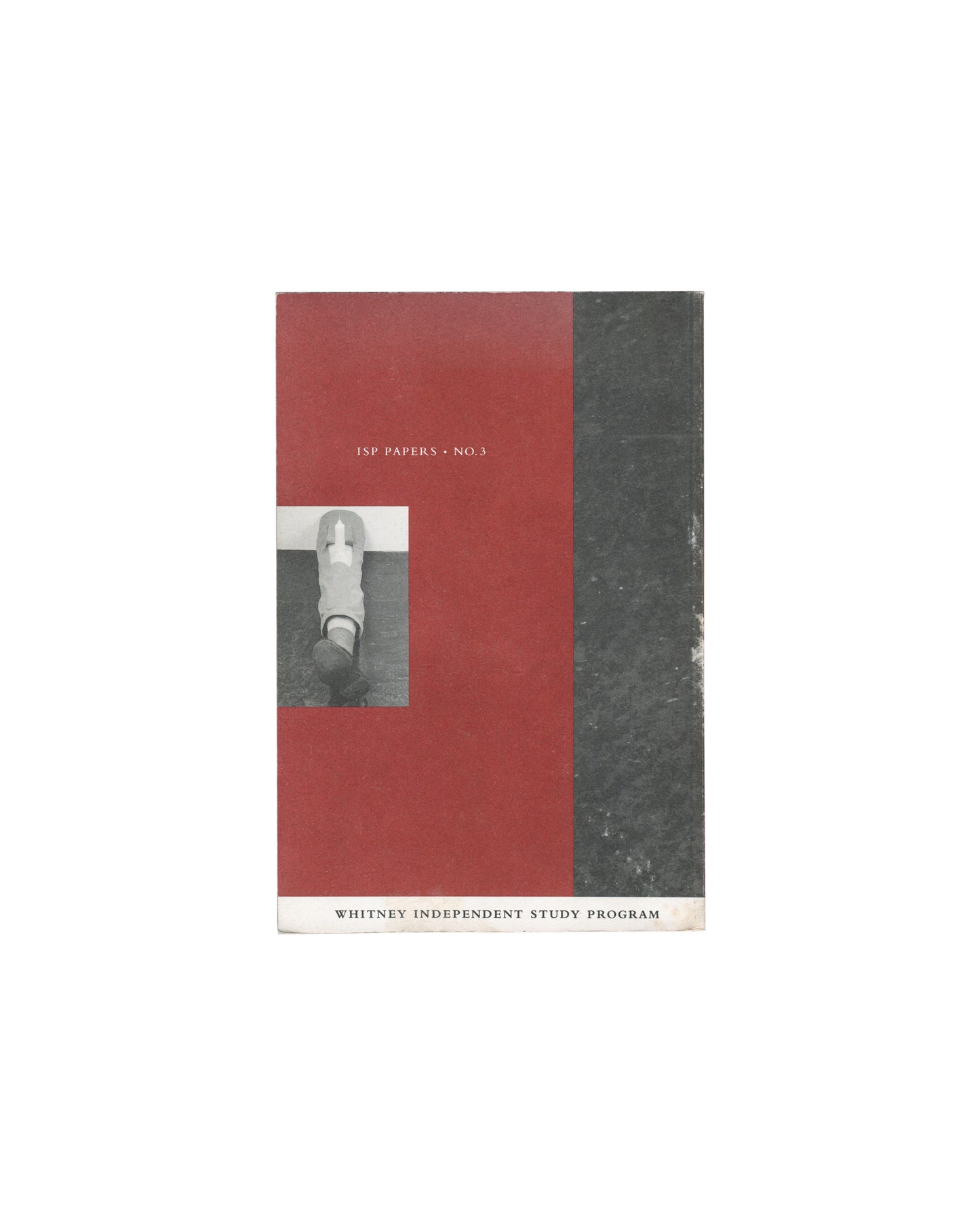
The cover makes the argument before the book is opened. Robert Gober’s severed trousered leg — wax, human hair, cloth, shoe and candle transformed into an uncanny fragment of the male body — sits against a surface derived from Andy Warhol’s Oxidation Paintings, works produced through the chemical reaction of urine on copper pigment. Body fragment on bodily fluid. Underneath it all, perfectly typeset: WHITNEY MUSEUM OF AMERICAN ART.
Inside, Claes Oldenburg’s Soft Toilet becomes a collapse of the clean, hard mechanism designed to make bodily waste disappear. Yayoi Kusama appears in Leslie C. Jones’s essay “Transgressive Femininity,” where apparently similar sculptural gestures acquire very different meanings according to the gender of the artist who makes them. Other essays move through sadomasochism, queer identity, phobia, bodily fragmentation and the politics of representing people already treated as socially improper.
While Abject Art was still on view, the exhibition entered debates in the United States Congress over National Endowment for the Arts funding. Its language and imagery were used by conservative opponents as evidence of precisely the kind of culture they believed public institutions should not support. An exhibition about abjection — about deciding what must remain outside — becomes something political opponents attempt to push outside the legitimate museum itself.
The catalogue survives as more than documentation of a provocative Whitney exhibition. It records the moment “abjection” moved from psychoanalytic theory into institutional art history, and institutional art history moved directly into political argument.
Whitney Museum of American Art, New York, 1993. ISP Papers No. 3. Approx. 23 × 16 cm, 111 pages, illustrated softcover.
Condition: Good. General handling and shelf wear, rubbing and surface marking to covers, with wear along edges and extremities consistent with age and use. Complete, with handwritten notes by a previous owner inside.
Share