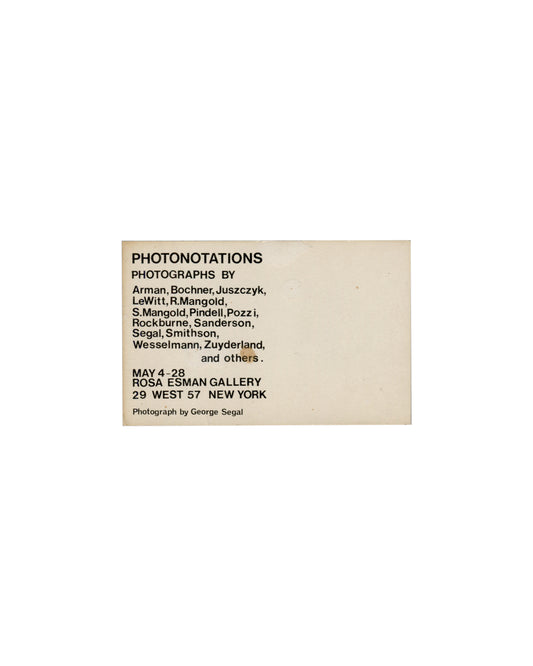
Collection: Robert Smithson
Robert Smithson (1938–1973) was an American artist whose practice ranged across sculpture, land art, photography, film and writing, and whose work fundamentally altered the terms on which art could engage with landscape, time and entropy. Working in New York from the early 1960s, Smithson developed a body of work in which geological time, industrial sites and the processes of material decay became both subject and medium.
His most celebrated work, Spiral Jetty (1970), a 1,500-foot coil of black basalt and earth extending into the Great Salt Lake in Utah, remains one of the defining works of Land Art. Alongside his large-scale earthworks, Smithson produced an extensive body of site and non-site works, mirror displacements, films and critical writing that positioned the artist as one of the most rigorous theorists of his generation.
Smithson’s engagement with photography was central to his practice: photographs, maps and geological samples were used to establish the conceptual relationship between remote sites and gallery-based non-sites. His participation in group exhibitions such as Photonotations (Rosa Esman Gallery, 1976) reflects the broader interest among his contemporaries in photography as an artistic medium in its own right. Smithson died in a plane crash in 1973 while surveying the site of his earthwork Amarillo Ramp.