Collection: Georges Braque
Georges Braque (1882–1963, Argenteuil) was a French painter and sculptor whose collaboration with Pablo Picasso between 1908 and 1914 produced Cubism, one of the most consequential developments in the history of modern art. Working initially as a Fauvist, Braque encountered Picasso’s work in 1907 and the two artists entered into an intense period of mutual exchange that dissolved the conventions of single-point perspective and produced a new pictorial language of fragmented planes, multiple viewpoints and collaged surfaces.
Braque’s Analytic Cubist works of 1909–12 — still lifes of musical instruments, bottles, newspapers and playing cards rendered in muted ochres, greys and browns — are among the defining images of twentieth-century painting. His introduction of papier collé in 1912, incorporating fragments of newspaper and wallpaper directly into the painted surface, extended Cubism into collage and anticipated the material experiments of Dada and Constructivism.
Following serious injury in the First World War, Braque developed a more personal and lyrical style, producing the celebrated series of studio interiors, birds and landscapes that occupied him through the 1930s, 1940s and 1950s. His late work, including the monumental Atelier paintings and the ceiling of the Salle Henri II at the Louvre (1953), confirmed his position as one of the central figures of European modernism.
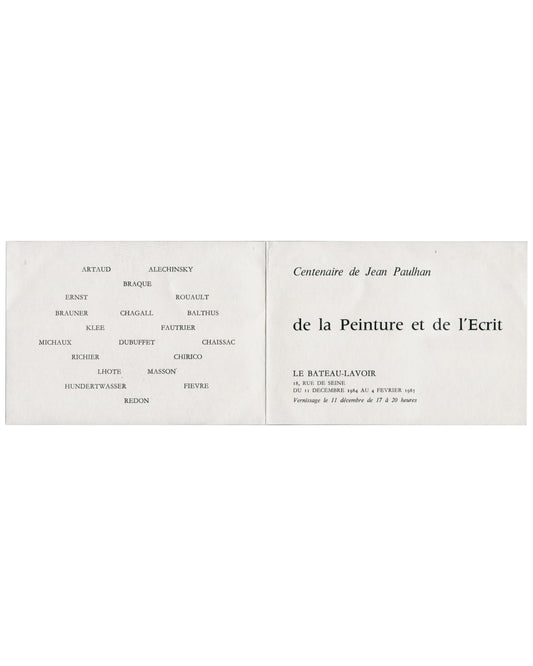
Braque’s inclusion in Centenaire de Jean Paulhan: De la peinture et de l’écrit (Le Bateau-Lavoir, Paris, 1984) reflects his longstanding friendship with Paulhan and his engagement with the relationship between painting and writing. His work is held in every major collection of modern art internationally.