Collection: George Segal
George Segal (1924–2000, New York) was an American sculptor and photographer whose practice from the late 1950s onwards developed a distinctive figurative language rooted in the everyday environments of American life. Working initially as a painter, Segal turned to sculpture in the early 1960s, producing life-size plaster casts of human figures placed within real objects and environments — bus stops, diners, cinema lobbies — to create works of quiet, existential intensity.
His casting process, which involved wrapping live models in plaster-soaked bandages, produced figures of raw, unfinished whiteness that stood in deliberate contrast to the polished surfaces of mainstream sculpture. Works such as The Bus Driver (1962) and The Diner (1964–66) established Segal as a major figure in American Pop Art and New Realism, though his work consistently resisted the ironic detachment associated with those movements in favour of a more melancholic humanism.
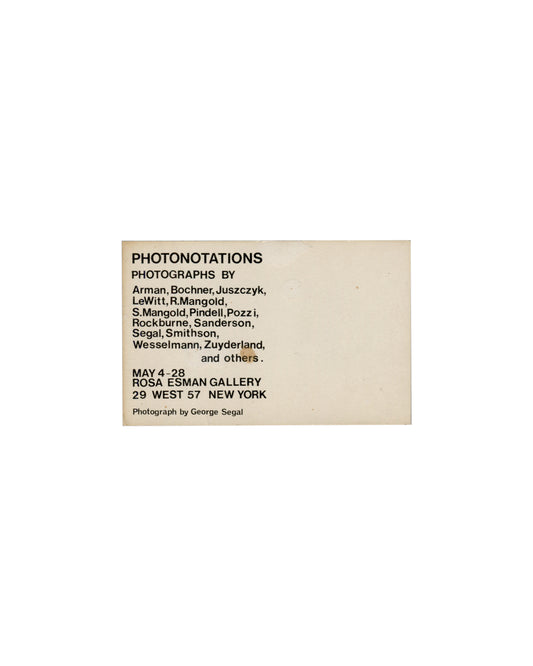
Segal’s participation in Photonotations (Rosa Esman Gallery, 1976) — for which he also provided the cover photograph, a silhouetted figure working across an illuminated theatre marquee — reflects his sustained engagement with photography as both documentary tool and artistic medium. His work is held in major collections internationally, including the Museum of Modern Art, New York, and the Hirshhorn Museum, Washington D.C.